Timer vs Light Sensor Automatic Chicken Coop Door: Which Is Better?
Affiliate disclosure: Coop Automation Lab may earn a commission if you buy through links on this page, at no extra cost to you. We only recommend products based on research, specifications, owner feedback, and practical backyard chicken-keeping needs.
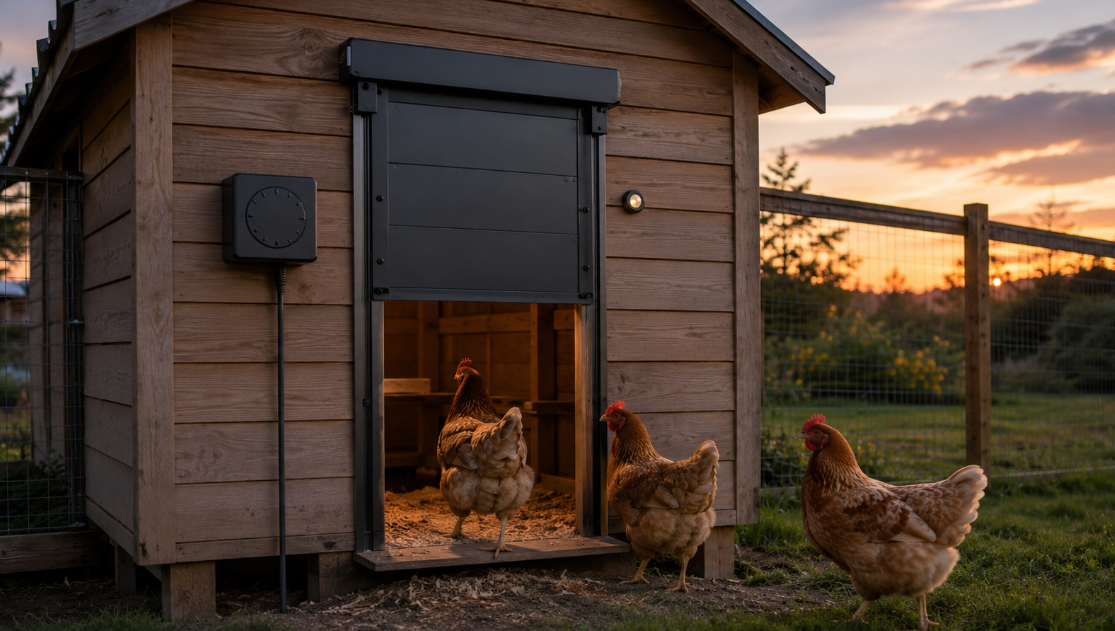
An automatic chicken coop door can open and close in several ways. The most common options are a fixed timer, a light sensor that reacts to dawn and dusk, manual control, app control, or a combined mode that uses more than one rule.
For most backyard flocks, the safest setup is not simply “timer” or “light sensor.” It is usually a door that lets you combine a predictable schedule with daylight-based behavior, then adjust it for your flock, predators, and season.
Here is the short version:
- Timer mode is better when you want predictable open and close times, have artificial lights near the coop, or need to avoid the door reacting to cloudy weather, shade, headlights, or security lights.
- Light sensor mode is better when you want the door to follow natural sunrise and sunset without constant seasonal adjustments.
- Combined timer + light sensor mode is usually safest when available, because it can prevent the door from opening too early or closing too late while still adapting to changing daylight.
- Manual or app control is useful as a backup, but it should not be the only protection if you regularly forget, travel, lose signal, or have predators nearby.
The right answer depends on how your chickens behave at dusk, how exposed your coop is, how much predator pressure you have, and whether your door lets you set delays, limits, or separate open and close rules.
What timer mode does
A timer-based automatic coop door opens and closes at times you choose. For example, you might set it to open at 7:00 a.m. and close at 8:30 p.m. The door follows its clock rather than measuring the amount of daylight.
That makes timer mode simple and predictable. You know exactly when the door is supposed to move. If the door closes late, opens too early, or does not move, you can compare the result against the schedule.
What light sensor mode does
A light sensor mode uses ambient light to decide when to open and close. Instead of following a fixed clock, the door reacts when the area around the sensor becomes bright enough in the morning or dark enough in the evening.
The big advantage is seasonal adjustment. In theory, a light sensor follows the changing sunrise and sunset naturally. You do not have to keep moving the timer earlier or later as the days get longer or shorter.
That can be especially useful for owners who do not want to revisit door settings every few weeks. It also matches the way chickens usually behave: they tend to leave the roost after daylight and return to the coop as light fades.
Quick comparison: timer vs light sensor
| Control mode | Best for | Main advantage | Main drawback |
|---|---|---|---|
| Timer | Predictable routines, artificial lights, high control | Opens/closes at exact times | Needs seasonal adjustment and clock checks |
| Light sensor | Natural daylight changes, hands-off seasonal use | Follows sunrise/sunset more automatically | Can be affected by shade, clouds, coop lights, and sensor placement |
| Combined timer + sensor | Most backyard flocks with predator concerns | Adds guardrails around daylight behavior | Requires more setup and a door that supports it |
| Manual/app control | Overrides, checks, unusual days | Owner can intervene | Not reliable if you forget, lose signal, or are away |
When a timer is better
Timer mode is often the better choice when the environment around the coop has confusing light conditions.
Use timer mode if artificial lights are nearby
Light sensors can be confused by non-sunlight sources. A porch light, motion light, barn light, Christmas lights, driveway light, or coop interior light may make the sensor think it is still daytime.
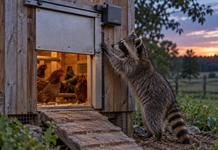
That matters most at closing time. If the sensor reads too much light after dusk, the door may stay open longer than intended. In an area with raccoons, foxes, coyotes, neighborhood dogs, or other predators, an open pop door after dark is a serious risk.
Use timer mode if the coop sits in heavy shade
A shaded sensor may think dusk arrives earlier than it really does. Trees, fences, roof overhangs, dense shrubs, nearby buildings, or a north-facing wall can all change what the sensor reads.
In the morning, deep shade may delay opening. In the evening, it may close the door before the whole flock has gone inside.
Use timer mode if predators arrive before full dark
Some predators do not wait until black night. Raccoons, foxes, coyotes, dogs, and other threats may start moving at dusk or even before sunset. If you regularly see predators near the coop in the evening, you may not want a door that stays open until the sensor decides it is dark enough.
A timer lets you set a firmer closing target. The tradeoff is that you must choose a time that still gives your chickens a fair chance to get inside.
Use timer mode if you want a consistent winter routine
Winter days are short. In some locations, chickens may be heading in very early. If you work late or cannot check the coop at dusk, a predictable timer can be reassuring.
Use timer mode if your flock has predictable habits
Some flocks are consistent. They come out at the same time, return early, and rarely linger outside after dusk. If that describes your birds, timer mode can be simple and reliable.
When a light sensor is better
Light sensor mode is often better when you want the door to follow natural daylight without frequent manual adjustments.
Use light sensor mode if seasonal daylight changes are your main headache
Day length changes a lot between summer and winter. A fixed schedule that feels perfect in one season can become annoying or unsafe in another.
Light sensor mode handles that better because it reacts to actual dawn and dusk at the coop. That can reduce the need to update settings every few weeks.
Use light sensor mode if there are no confusing lights nearby
A light sensor works best when it has a clean read on outdoor daylight. A coop in an open area, away from porch lights and vehicle headlights, is a better fit than a coop tucked under a lit deck or beside a motion-sensor floodlight.
Use light sensor mode if your chickens follow dusk reliably
Chickens naturally move toward the coop as evening light fades. If your flock consistently goes inside before the sensor triggers closing, light mode may fit their behavior well.
Use light sensor mode if daylight saving time causes mistakes
Daylight saving time does not change sunrise or sunset from a chicken’s point of view, but it does change human clocks. Timer doors can end up an hour off if the clock is not updated or if the app handles time changes in a way you did not expect.
A light sensor avoids some of that because it is watching light instead of the clock. You should still inspect the door after time changes, but sensor mode can reduce schedule confusion.
Why combined timer + light sensor is often safest
If your door supports combined rules, this is usually the most useful setup. Different brands use different names for this behavior, and not all doors support the same combinations. Before buying, check the current product manual for the exact model.
A combined setup might work in a few ways:
- open by light sensor, but not before a set time
- close by light sensor, but not after a set time
- open by timer and close by sensor
- open by sensor and close by timer
- close only when both a darkness threshold and a time condition are met
- use a timer delay after the sensor detects dusk
The safest logic depends on your site, but the idea is the same: one control method acts as the main trigger, and the other acts as a guardrail.
Example: sensor close with a latest-close limit
A light sensor may be convenient at dusk, but you may not want the door waiting too late on a cloudy-to-clear evening, near a porch light, or under snow glare.
A latest-close limit can help: the door follows dusk normally, but if it has not closed by a certain time, the timer takes over.
Example: sensor open with an earliest-open limit
Some owners do not want the door opening at the first hint of dawn. Predators may still be active, and chickens may not need access to the run that early.
An earliest-open limit can help: the door waits for daylight, but it will not open before a set time.
Example: timer close with a daylight check
A fixed close time is predictable, but it can close too early if the season changes or if you set it aggressively. A daylight check or delay can help prevent the door from closing while there is still enough natural light that birds are likely outside.
Practical tradeoffs owners should think through
Choosing the mode is not just a settings question. It is a flock-management question.
Seasonal daylight changes
Timer mode requires more seasonal attention. Light sensor mode adapts better. Combined mode is usually best if it gives you both adaptation and limits.
Cloudy weather and storms
A heavy storm can make the coop area darker than usual. Depending on the sensor threshold and delay, a light-based door may behave differently on stormy days than on clear days.
Winter short days
Winter makes every weakness more obvious. Batteries may struggle, tracks can freeze, bedding can build up, and birds may spend more time near the coop. For winter buying criteria, see Best Automatic Chicken Coop Doors for Cold Weather.
A timer can give a predictable winter close. A sensor can adapt as sunset shifts. Combined rules can add a latest-close backup.
Predators at dusk
Closing too late is the main danger of an automatic door. Chickens may go in around dusk, but predators may also become active around dusk.
If you have heavy predator pressure, prioritize a secure door design, reliable closing, manual override, and a conservative evening setting. Do not rely on a door mode alone to make a weak coop safe.
Chickens going in late
Some chickens linger outside. Young birds, new birds, low-ranking hens, or birds distracted by feed and bugs may not enter with the rest of the flock.
Before locking in a close setting, observe the last bird for several evenings. If one hen is always late, look for a cause: bullying at the pop door, poor ramp traction, not enough roost space, a dark coop interior, or treats being offered outside too late.
Do not solve a behavior problem by leaving the door open for hours after dark unless the run is predator-resistant enough for that risk.
Artificial lights
Artificial light is one of the strongest arguments against sensor-only closing. A sensor may read a nearby light as daylight. Interior coop lights can also affect behavior by encouraging chickens to stay active later than they otherwise would.
If you use coop lighting for winter egg production or evening chores, timer mode or combined mode may be safer than sensor-only mode. Keep the door sensor away from direct artificial light when possible.
Daylight saving time
Daylight saving time is mostly a timer problem. If the door’s clock shifts unexpectedly, or if it does not shift when you expect it to, the schedule can be wrong by an hour.
After every time change, confirm:
- current clock time
- AM/PM setting
- open time
- close time
- active mode
- app time zone, if applicable
If the door behaves strangely after a schedule change, start with the checks in Automatic Chicken Coop Door Not Closing.
Reliability and owner convenience
A simple timer is easy to understand. A sensor is more automatic through the seasons. An app can be convenient if it works reliably where your coop is located. Manual control is essential as a backup.
But more features do not always mean fewer problems. A complicated setup can fail because of poor Wi-Fi, a dead phone battery, unclear menus, firmware behavior, or settings that were not saved.
What about app control and manual mode?
App control can be useful if it makes schedules easier to change or shows door status, battery level, or open/closed state. Treat it as convenience, not the only safety layer. Coops are often at the edge of Wi-Fi range, phones die, notifications get missed, and apps change.
Manual mode is important for chores, training birds, cleaning the coop, and emergency override. Every automatic door should have a way to open or close it manually according to the manufacturer instructions.
Product-specific examples, cautiously
Popular automatic coop door brands often advertise some mix of timer, light sensor, manual, app, or combined control. Examples commonly discussed by backyard owners include Omlet, ChickenGuard, Run-Chicken, ADOR, and similar brands.
Do not buy based on the brand name alone. Verify the exact current model manual before relying on a feature. Check whether it supports timer mode, light sensor mode, separate open/close rules, dawn or dusk delays, earliest-open or latest-close limits, manual override, low-battery warnings, and retained settings after battery loss.
Features can vary by model and generation, so product-specific claims should be checked against current manufacturer documentation before publishing or purchasing.
Recommended setup by situation
Best default for most owners: combined mode
If available, use a light sensor with timer guardrails. A practical setup might be:
- open after daylight is detected, but not before your chosen earliest time
- close at dusk or after a short dusk delay, but no later than your chosen latest time
- test the setting by watching the flock for several evenings
This balances natural chicken behavior with predator safety.
Best for coops near lights: timer mode
If porch lights, floodlights, vehicle headlights, or coop lights hit the sensor, use timer mode or relocate/shield the sensor according to the manual.
Set the close time based on when the last chicken reliably enters, not when the first chicken roosts.
Best for changing seasons with low light interference: sensor mode
If the coop has a clean outdoor light reading and low predator pressure at early dusk, light sensor mode can be convenient. Use delay settings if the door supports them, and check the door after storms, snow, and seasonal changes.
Best for high predator pressure: conservative combined setup
If predators are common, do not leave closing to chance. Use a secure door, strong coop construction, and a closing rule that does not drift late. Combined mode with a latest-close limit is usually preferable if your door supports it.
Best for unreliable flock behavior: observe first, then set
If chickens often stay out late, the answer is not automatically to delay closing forever. Watch why they are late. Improve ramp access, reduce bullying, adjust feed timing, make the coop interior inviting, and avoid training birds to wait outside for evening treats.
Then choose a closing mode that matches the corrected routine.
Buying checklist: control features to look for
When comparing automatic chicken coop doors, prioritize control features that make the door predictable and recoverable:
- timer and light sensor options
- separate open and close rules
- dusk/dawn delay settings
- earliest-open and latest-close limits
- manual open/close control at the coop
- clear display or app status
- low-battery warning
- clear behavior after battery change or power loss
- manufacturer instructions for sensor placement
For many owners, the ability to combine modes is worth prioritizing over a door that only offers a basic timer or a basic sensor. To compare those controls alongside power, door design, and installation fit, see our best automatic chicken coop doors buyer’s guide.
Final recommendation
If you want the simplest answer: choose an automatic chicken coop door that supports both timer and light sensor control, then use the timer as a safety limit around the light sensor when possible.
Use timer mode when artificial lights, heavy shade, predator schedules, or your own routine make exact timing more reliable. Use light sensor mode when natural daylight changes are the bigger issue and the sensor has a clean, consistent view of outdoor light.
Whichever mode you choose, do not install it once and forget it. Watch the first several open and close cycles. Recheck after battery changes, daylight saving time changes, storms, snow, Wi-Fi problems, flock changes, and winter weather.
An automatic coop door is a convenience tool, but at dusk it is also part of your predator protection. The best setting is the one that reliably closes after your chickens are inside and before the coop becomes an easy target.