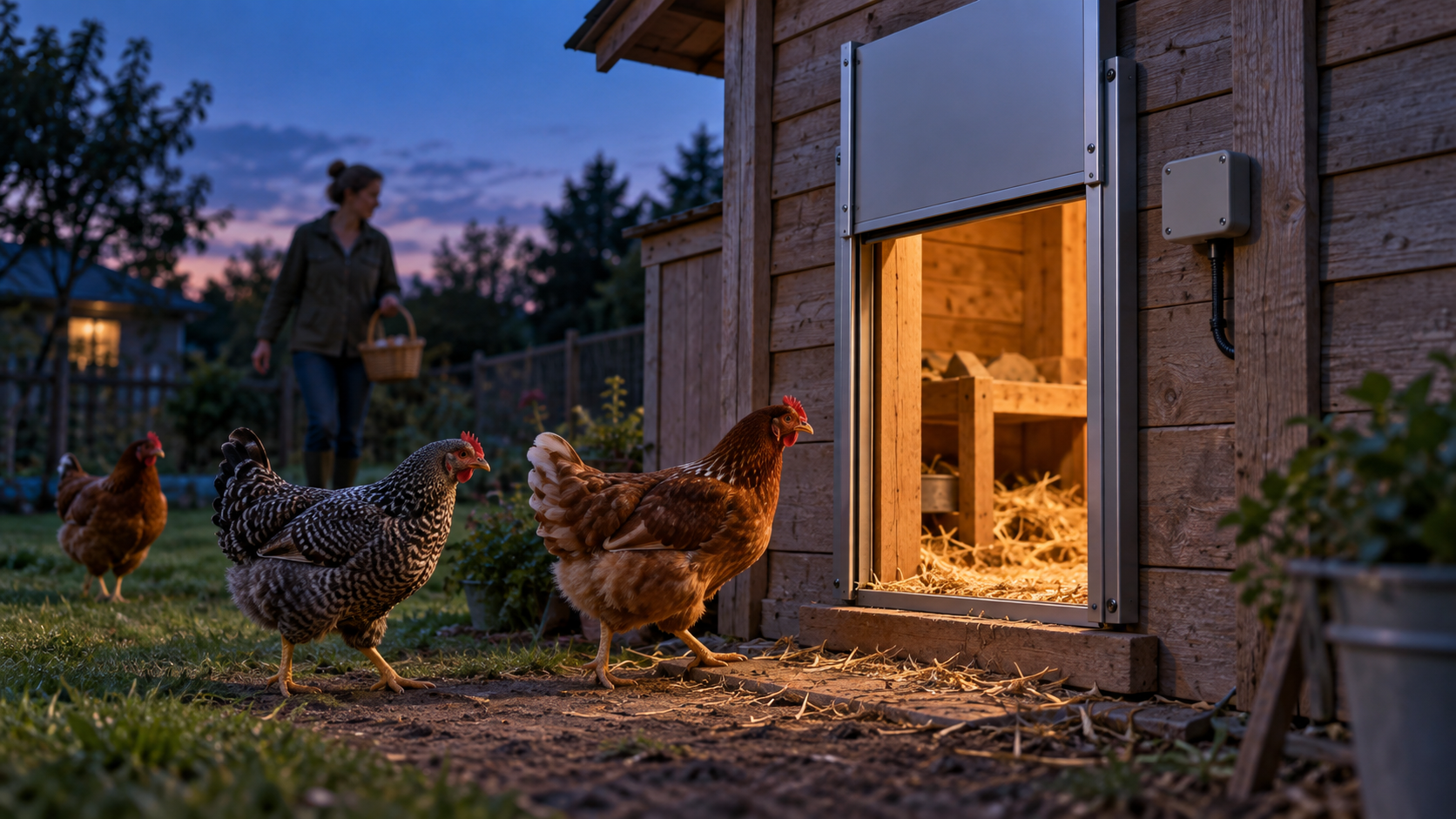
Are automatic chicken coop doors worth it? Usually, yes—when opening and closing the coop at dawn and dusk is a real burden, the birds already roost reliably, and the door can be installed in a suitable, secure coop. Automating that repetitive job can make early mornings, late work shifts, seasonal daylight changes, and occasional schedule disruptions easier to manage.
But an automatic door does not automate chicken care. It cannot confirm that every bird is inside, repair a weak coop, clear ice or bedding, or guarantee that a closing cycle succeeds. You still need flock checks, maintenance, and a plan for low power, obstruction, bad weather, or a failed closure. Its value depends less on having the most features and more on whether the door fits your routine, coop, environment, and willingness to monitor it.
What an automatic chicken coop door actually does
An automatic coop door opens and closes the flock's pop-hole according to a control method such as a fixed timer, measured daylight, calculated sunrise and sunset, or app-configured rules. Some products are complete doors. Others are openers or kits designed to move a compatible existing door.
The practical benefit is narrow but meaningful: the keeper does not have to be physically present for every routine opening and closing. That can improve consistency and reduce schedule pressure.
It is equally important to understand what the mechanism does not know. A typical door controller monitors settings, light, motor movement, or a reported door state—not the location and condition of each chicken. Even when an app reports “closed,” that status does not prove that every bird entered the coop.
This guide is based on current manuals, manufacturer information, and limited owner feedback available during research. Coop Automation Lab has not personally tested these products. Manufacturer performance and safety statements should be treated as claims unless independently established, and product behavior must be checked against the current manual for the exact model.
Quick decision table: likely worth it, conditional, or not yet
| Your situation | Decision | Why |
|---|---|---|
| Dawn or dusk regularly conflicts with work, sleep, mobility, or family commitments | Likely worth it | The door automates a recurring, time-sensitive burden. |
| Secure fixed coop, suitable opening, and an established flock that roosts predictably | Likely worth it | Good physical fit and consistent bird behavior reduce avoidable problems. |
| Travel or late returns, with a dependable person available for checks and faults | Likely worth it | Automation reduces routine visits while backup care covers what it cannot do. |
| Off-grid coop with a maintainable battery or adequate year-round solar exposure | Conditional | It can work well, but reserve power depends on the installation, season, battery, and load. |
| Frequent snow, ice, mud, bedding buildup, deep shade, or unreliable connectivity | Conditional | The site may require more maintenance, a different power/control choice, or better weather protection. |
| Chicks, new birds, injured or bullied birds, or a flock that enters inconsistently | Not yet | Closing time needs close supervision until bird behavior and model suitability are clear. |
| Weak walls, vents, mesh, latches, roof, floor, or run | Not yet | Automating one opening does not fix the rest of an insecure coop. |
| Nobody can inspect the door or respond for an extended period | Not yet | Power, control, mechanical, and weather-related faults still need human intervention. |
The main benefits
Less pressure at dawn and dusk
The strongest reason to buy an automatic door is simple: it takes one repeated deadline off your daily schedule. That can matter during early summer sunrises, short winter afternoons, shift work, school runs, mobility limitations, or evenings when getting home before dark is difficult.
This convenience is not the same as eliminating coop visits. It means you can move the health check, feed and water check, cleaning, or egg collection to a practical time instead of tying every day to the pop-door schedule.
More consistent access times
Current doors offer combinations of timer, ambient-light, calculated sunrise/sunset, and manual controls. Correctly configured automation may be more consistent than a keeper whose schedule changes daily.
Consistency can support a routine; it does not guarantee a successful cycle. A door may encounter low power, debris, ice, misalignment, an incorrect setting, or another model-specific fault. Physical confirmation remains important.
The drawbacks and limitations
It adds another system that can fail
A manual door has few parts. Automation adds a motor, power source, controller, sensor or clock, and sometimes an app or network connection. Depending on the model, documented problems can include depleted batteries, binding, debris, sensor interference, alignment issues, or motor and control errors.
Different failures have different consequences. A door that remains open leaves the pop-hole accessible. A door that remains closed can keep birds on the wrong side. A partly moved door may require immediate attention. You need to know how to operate the exact model manually before that happens.
Installation can be more involved than expected
The bird opening is only one measurement. A complete unit may need wall space above or beside it, a sliding panel needs a clear travel path, and a swing door needs an unobstructed arc. The mounting surface must be flat and rigid enough to avoid twisting the frame.
An opener kit also has to be compatible with the weight, movement, and geometry of the door it controls. A product that fits on paper can still be a poor choice for warped timber, thin siding, a mobile tractor, or an opening that constantly collects bedding.
Convenience comes with upkeep
Cleaning tracks or panels, checking batteries, keeping a solar panel exposed, reviewing settings, testing manual operation, and watching for movement changes are part of ownership. The required method and frequency vary by product and conditions; there is no defensible universal maintenance interval for every automatic door.
Total ownership effort: what “worth it” really includes
There is no universal payback calculation. The value of sleeping through an early sunrise, getting home after dark without leaving the pop-hole open, or reducing a mobility burden is personal. Product prices, installation needs, service life, and repair paths also vary, so a single dollar ROI would be misleading.
Instead, consider the complete ownership burden:
- Purchase: The door or opener, plus any required panel, tracks, mounting kit, power supply, or solar components.
- Installation: Measuring, cutting, reinforcing, weather-protecting, routing power, and adjusting the opening.
- Commissioning: Programming controls and watching enough full cycles to confirm that the door and flock behave as expected.
- Power: Replacing or charging approved batteries, cleaning and positioning a solar panel, or maintaining a safe wired supply and outage plan.
- Routine attention: Checking the flock, physical closure, threshold, tracks, alignment, and status indicators.
- Long-term support: Finding manuals, replacement parts, batteries, service, and a workable manual method if the automatic system stops.
- Eventual repair or replacement: No mechanism should be assumed to last indefinitely.
The door is more likely to be worthwhile when the scheduling relief is significant and those ownership tasks are manageable. If manual opening already fits naturally into twice-daily flock care, the gain may be small.
Power choices: battery, solar, or mains
Replaceable or rechargeable batteries
Battery operation is straightforward for a remote coop and can continue through a household power outage. Its main weakness is finite reserve. Temperature, battery chemistry and quality, motor resistance, settings, accessories, and repeated retries can affect useful life.
Do not treat an advertised battery-life figure as your replacement schedule. Use only the type specified for the model, watch its low-power indications, and replace or recharge proactively before travel or difficult weather.
Solar-assisted power
Solar can be a practical off-grid choice when a correctly positioned panel and compatible battery have enough reserve for the worst part of the year. It is not independent of weather or maintenance. Shade, short winter days, snow, dirt, panel orientation, battery condition, accessory load, and charging-temperature restrictions can all matter.
Available owner anecdotes about solar performance conflict and are manufacturer-hosted, so they cannot establish a general success or failure rate. If solar is central to your decision, compare the site requirements in our guide to the best solar automatic chicken coop doors.
Mains or a low-voltage adapter
Wired power can reduce battery chores and may support connected features, depending on the product. It also creates dependence on the electrical supply unless the system has a suitable backup. Outdoor wiring, outlets, adapters, and cable routing must be safe and appropriate for the location. An improvised extension cord is not a robust long-term plan.
Whichever option you choose, ask: What does this exact model do at low power or during an outage? Does it warn, stop, remain in its last position, or continue locally? Do not assume the answer is the same across products.
Controls: timer, light sensor, calculated sun times, or app?
Fixed timer
A timer provides predictable clock-based opening and closing. It is less vulnerable to a porch light or night-vision camera confusing a light sensor. However, a fixed schedule needs review as day length changes and after clock, daylight-saving, or power events where relevant.
Ambient-light sensor
A light sensor follows measured daylight without requiring constant clock changes. Its timing depends on sensor placement and the actual environment. Trees, deep shade, storms, snow reflection, porch lights, heat lamps, and infrared illumination from some cameras may affect certain sensors.
Calculated sunrise and sunset
Some controllers calculate local sun times and allow an offset. This avoids measuring ambient light but still depends on correct setup. A calculated sunset is not evidence that a slow or newly introduced bird has entered.
Bluetooth or Wi-Fi/app controls
An app can simplify configuration, manual control, status, or notifications. Connectivity type matters. Bluetooth generally means nearby access; it should not be mistaken for internet-anywhere monitoring. Wi-Fi can offer remote features when the coop has power, signal, and a functioning service.
Smart status is helpful, but it should supplement physical checks. Confirm whether the exact door continues its automatic schedule if Bluetooth, Wi-Fi, internet service, or the app becomes unavailable.
No control method is universally best. Match it to how your flock behaves at the exact coop. Our detailed timer vs light sensor automatic coop doors guide walks through the scheduling tradeoffs.
Installation fit and commissioning
Measure before choosing a control type or smart feature. Check:
- Usable bird opening: Observe the largest bird, including any bird with limited mobility. Do not assume a nominal opening suits every breed or flock.
- Cutout and total footprint: The passage, cutout, frame, controller, and full moving-door clearance can all have different dimensions.
- Movement: Vertical and horizontal sliding doors need straight, clean travel. Swing doors need a clear arc that wind, fencing, or stored equipment cannot obstruct.
- Wall condition: The mounting area should be flat, rigid, and sound. Reinforcement or shimming may be needed according to the instructions.
- Threshold: Keep the moving edge away from routine bedding, manure, mud, and runoff while preserving comfortable bird access.
- Sensor position: A light sensor needs appropriate exposure without interference from coop lighting or nearby infrared sources.
- Power: Confirm safe cable routing or year-round solar exposure before cutting the wall.
- Service access: You must be able to reach controls, batteries, fasteners, and the manual release in darkness and bad weather.
After installation, observe several complete automatic opening and closing cycles from both sides. Watch the flock at closing time while adjusting settings. Retest after battery changes, cleaning, app or firmware changes, severe weather, bedding changes, or movement in a timber wall. Do not rely on a newly installed door unattended before commissioning it.
Maintenance, weather, and winter use
Weather suitability is a combination of the product, installation, power source, and maintenance. A published temperature or water-ingress claim does not show how a door will perform with wet bedding frozen against its threshold, roof runoff entering a track, or a cold-depleted battery.
Keep the travel path free of bedding, feathers, manure, mud, cobwebs, snow, and ice. Check panel movement and mounting alignment. Follow the model's cleaning instructions: for example, some manuals prohibit lubricating rails, so adding oil without checking the manual can make matters worse.
Inspect and test after storms, freeze-thaw cycles, impacts, coop clean-outs, or changes in motor sound or travel time. In cold climates, choose a power source and battery chemistry supported by the manufacturer and keep a manual contingency. Our guide to automatic chicken coop doors for cold weather covers winter-specific selection criteria without assuming a temperature claim prevents jams.
Can an automatic door keep predators out?
An automatic door can make closing the pop-hole more consistent and some designs include locks, positive drives, guards, or anti-lift features. These are useful characteristics when documented. Coop Automation Lab has not attack-tested them, and manufacturer security language should not be turned into a guarantee.
A secure coop is a complete system. Inspect the door's frame and fasteners, but also inspect vents, mesh, corners, latches, walls, roof, floor, and any attached run. Gaps or weak hardware elsewhere are not fixed by automating the pop-hole.
Timing matters too. A strong closed door does not help a chicken that was shut outside, and obstruction, low power, ice, or misalignment can prevent intended closure. Think of automation as one layer in a broader routine—not as proof that the flock is secure.
Obstruction and closing-safety limits
Terms such as “anti-pinch,” “auto-stop,” and “safety sensor” do not describe one standardized behavior. Depending on the exact product and configuration, a door may stop, pause, reverse, retry, or follow another sequence. Published information often omits force thresholds, clearance, retry timing, and limitations for very small birds.
Do not infer that an obstruction feature makes a door safe for chicks, small birds, pets, or children. For some products, a protective setting may need to be enabled or calibrated. Follow the current manual, ask the manufacturer when the sequence is unclear, and watch early cycles closely.
Never test closing behavior with a chicken, hand, child, or pet. If the manufacturer provides a safe test procedure, use an appropriate inanimate object and follow that procedure exactly. Chicks, new birds, injured birds, and inconsistent late roosters deserve direct supervision until their behavior and the door's suitability are clear.
Plan for failure before relying on the door
A useful backup plan answers these questions before the first unattended cycle:
- Can you open and close the door manually without power or an app?
- Can you reach that control safely in darkness, rain, or snow?
- What low-battery, obstruction, or fault signals does this model provide?
- What happens to the local schedule if Wi-Fi, Bluetooth, internet service, or the app is unavailable?
- Who can physically check the flock and door when you are away?
- Do you have approved spare batteries or another suitable power contingency?
- Where will birds be safest if the mechanism must remain out of service?
If the unit fails to close, secure the flock first using the model's documented manual procedure or another suitable barrier. Then inspect power, settings, the travel path, alignment, and indicated errors according to the manual. Our troubleshooting guide explains what to check when an automatic chicken coop door is not closing.
Who is most likely to find one worthwhile?
This is usually a strong fit for keepers whose work, sleep, mobility, or family routine conflicts with dawn or dusk; established flocks that roost predictably; fixed, secure coops with suitable mounting surfaces; and households that can maintain the system and provide backup care.
Wait before automating if chicks or newly introduced, injured, bullied, or inconsistent birds need supervision; the coop has weak mesh, gaps, poor latches, damaged walls, or an unsuitable opening; solar exposure is doubtful; or nobody can inspect and respond. Fix the coop and establish the flock's routine first.
Buying checklist: decide before comparing products
Before shopping, write down the answers:
- What recurring dawn/dusk problem am I solving?
- Do my birds reliably enter before the planned closing time?
- Is the whole coop secure, including vents, mesh, walls, latches, roof, floor, and run connections?
- What opening size does my largest or least-mobile bird need?
- How much cutout, frame, headroom, side room, or swing clearance is available?
- Is the mounting surface flat, rigid, and protected from runoff and debris?
- Would a complete door or an opener/door kit suit this structure?
- Which power source is realistic in the worst season?
- Do I need exact clock times, changing daylight times, nearby app setup, or true remote status?
- What happens at low power, during a network outage, or when the door meets resistance?
- Is a manual override available and accessible?
- Are cleaning instructions, current manuals, replacement parts, and support available?
- Who will physically check the flock and respond while I am away?
Once those answers point toward automation, use our research-based guide to the best automatic chicken coop doors to compare current options by fit, controls, power, documentation, and support.
Frequently asked questions
Do automatic chicken coop doors work?
They can automate routine opening and closing when the model suits the installation, receives dependable power, is configured correctly, and is maintained. That does not mean every model behaves the same way or every cycle will succeed. Continue checking the flock and keep a manual backup plan.
Do I still need to check my chickens at night?
Yes. Confirm that every bird is inside and the opening is physically closed. A reported closed state is not an individual-bird count, and chickens may remain outside because they are new, late, injured, bullied, or disturbed.
Are automatic doors safe for chicks?
Do not assume they are. Obstruction behavior and force details vary and are often incomplete. Use a door with explicit manufacturer guidance for your bird size, enable any required safety setting, follow the current manual, and supervise closing. Very small or unpredictable birds may make automation a poor fit for now.
What happens if the battery dies or power fails?
Behavior is model-specific. A door might remain in its current position, stop during travel, issue an alert, or behave another documented way. Verify the exact low-power and outage behavior before purchase, learn the manual procedure, and maintain approved backup power where appropriate.
Will an automatic coop door work in winter?
It may, if the model, power source, mounting, and maintenance suit the conditions. A low-temperature claim does not prevent ice, snow, wet bedding, or misalignment from blocking movement, and cold can affect battery performance. Inspect after bad weather and keep a manual contingency.
Can I install one on an existing coop?
Often, but not universally. The coop needs a correctly sized opening, enough room for the full assembly and door movement, a flat and rigid mounting surface, suitable sensor exposure, and safe access to power and controls. An opener kit must also be compatible with the weight and movement of the door it operates.
Is a timer or light sensor better?
Neither is universally better. A timer is predictable but may need seasonal review. A light sensor follows actual light but can be affected by placement, shade, overcast conditions, and nearby artificial or infrared light. Calculated sunrise/sunset and hybrid controls offer other tradeoffs. Choose based on flock behavior at the actual coop.
Final verdict: is an automatic door worth it for your coop?
An automatic chicken coop door is usually worthwhile when it removes a genuine dawn/dusk burden from a keeper who has a suitable, secure coop and a predictable flock. It can make the daily routine more consistent and flexible, particularly for early starts, late shifts, mobility constraints, remote coops, or changing seasonal daylight.
It is not a replacement for flock checks, maintenance, or whole-coop security. You still need to confirm that birds are inside, keep the opening clear, maintain power, watch for weather and alignment problems, and know how to respond manually.
If those responsibilities are acceptable, automation can be a practical upgrade. If the coop is insecure, the flock is not ready, the installation is unsuitable, or nobody can respond to a fault, fix those issues before buying. The right question is not whether automatic doors are worthwhile for everyone; it is whether one solves a real problem in your setup without creating a maintenance or failure risk you cannot manage.