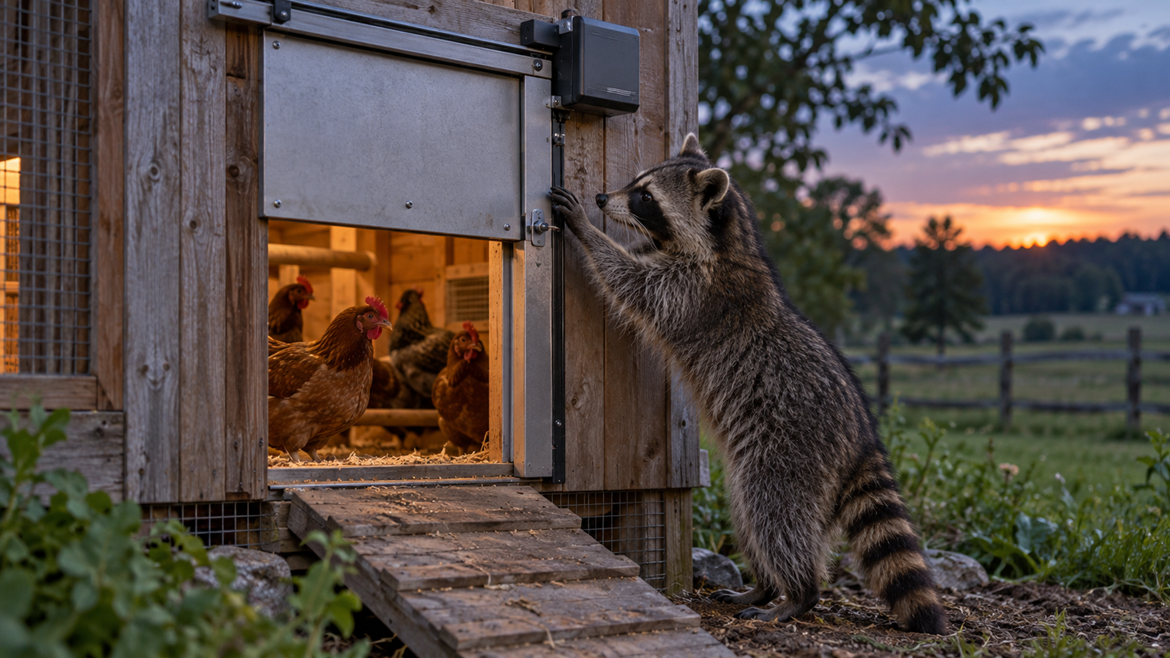
Yes, a raccoon may be able to open or defeat some automatic chicken coop doors and installations. “Automatic” is not the deciding factor. What matters is whether the closed panel can be lifted, pushed, or pried; whether a lock or drive positively holds it closed; whether the door reaches its fully closed position; and whether there are gaps or weaker entry points elsewhere in the coop.
A well-fitted door with a securely retained panel can be a useful part of nighttime protection. It still does not make the whole coop immune to predators. Power problems, debris, ice, installation movement, a bird left outside, or a weak vent or human door can bypass an otherwise strong automatic door.
This article is based on wildlife guidance and current manufacturer documentation. Coop Automation Lab has not attack-tested these doors, and product security statements below are identified as manufacturer claims rather than independent proof.
Why raccoons are a realistic door-security concern
This concern is not based only on raccoons being strong or persistent. Their ability to manipulate objects matters.
The Washington Department of Fish and Wildlife says raccoons have five dexterous toes on each front foot, allowing them to grasp and manipulate objects. Its guidance warns that raccoons can open various fasteners, latches, and containers. The Internet Center for Wildlife Damage Management likewise describes raccoons as dexterous, capable climbers and able to lift loose garbage-can lids.
Those are facts about raccoon behavior, but they do not mean every raccoon can solve every door. They do justify inspecting a coop from the perspective of an animal that can climb, pull, lift, reach, and repeatedly work at a weak point.
Wildlife guidance also looks beyond the pop door. WDFW recommends well-fitted poultry-house doors with secure locking mechanisms and securely connected pen seams. Extension poultry guidance warns about reach-through attacks and recommends a secure, covered enclosure. In practical terms, the automatic door is only one section of the coop's nighttime boundary.
Four ways an automatic coop-door setup can be defeated
Most concerns fit into four failure paths: the panel can be manipulated, the door fails to close completely, the installation is weaker than the door, or the raccoon enters another way.
1. Lifting, pushing, pulling, or prying the panel
A vertical sliding door is not automatically insecure. The important question is what prevents the panel from moving upward after it closes.
Some opener kits raise a panel with a string or cable and rely mainly on gravity to lower it. If that panel has no separate latch, anti-lift stop, or drive that remains engaged, the lifting line itself is not a positive lock. Mechanically, an exposed lower edge may offer more opportunity for lifting than a panel held by an engaged drive. That is an inference from how the mechanisms work—not evidence that a raccoon defeated every string-lift door.
A swing door avoids the simple lift-the-slider scenario, but it has other possible purchase points. Security depends on how its free edge is retained, whether the hinges and brackets are protected, how rigidly the frame is mounted, and whether the panel seats fully. Door orientation alone does not settle the question.
Prying is also different from lifting. A drive may resist reverse movement while the surrounding trim, siding, track, or lower edge flexes. A gap large enough for claws to gain purchase can shift the attack from the motor to the installation.
2. The door stops before it is fully closed
The best closed-state mechanism cannot help if the panel never reaches that state.
Official automatic-door documentation identifies several real causes of incomplete movement. ADOR support material discusses debris at the threshold, panel friction, warped or twisted frames, shallow sprocket engagement, loose parts, low battery, and motor or gear faults. The Pullet-Shut manual documents low-voltage behavior, pivot corrosion, damaged wiring, motor faults, and power-reset behavior for that model.
This distinction matters: a controller can receive a close command without the opening becoming securely closed. A status light or powered display also does not necessarily prove that the battery has enough reserve to move the door under load. ADOR specifically notes that a battery may power electronics while lacking enough power for the motor.
Obstruction features have limits too. Omlet says its Autodoor safety sensors stop closure when something is in the way. That is a manufacturer claim about an important bird-safety feature. It is reasonable to infer that a door stopped by an obstruction may remain open, but the sensor is not itself a security lock or proof of final closure.
Common closure hazards include:
- bedding, feathers, dirt, manure, mud, or a foreign object at the threshold;
- ice or frozen runoff around a panel, track, or pivot;
- a frame or timber wall that has shifted, swollen, twisted, or loosened;
- a depleted battery, weak solar reserve, power interruption, or damaged wiring;
- a slipping drive component, binding panel, corroded pivot, or failing motor; and
- incorrect timer, light-sensor, calibration, or operating-mode settings.
If cold-weather obstruction is a recurring concern, our guide to automatic chicken coop doors for cold weather explains the winter-specific tradeoffs in more detail.
3. The installation creates an easier weak point
A solid panel mounted to a flexible or badly fitted wall is still a weak installation. Look at the complete assembly: door, tracks or hinges, frame, siding, fasteners, threshold, trim, and the opening cut into the coop.
Wildlife guidance supports using well-fitted, securely fastened openings. Applying that guidance to an automatic door, it is reasonable to inspect for exposed edges, movable trim, loose fasteners, flexible mesh or siding, and gaps around the frame. This is mechanical inference, not a universal construction specification. The correct fasteners, clearances, and mounting method depend on the product and wall, so follow the current manual.
Installation can also create operating faults. ADOR's support documentation says mounting can twist a frame and contribute to binding. A door that moved freely on the workbench may not do so after uneven screws pull the frame against a warped coop wall.
Do not add a homemade latch or guard without considering the full travel path, manual release, and obstruction behavior. A modification that blocks automatic movement or prevents emergency operation can create a different safety problem. Check with the manufacturer when the instructions do not address a proposed change.
4. The raccoon bypasses the pop door
A retained, fully closed panel protects only its opening. A raccoon may instead exploit a loose human-door latch, damaged vent, weak seam, roof gap, run connection, flexible wire, digging point, or an opening created by rot or impact.
Climbing and reach-through risks matter as well. Wildlife and Extension sources describe raccoons as skilled climbers and warn that they can reach through enclosure wire. Check branches, roofs, run covers, mesh size and condition, corners, and connections—not only the ground-level pop door.
The other bypass is a chicken that never made it inside. A strong closed door cannot protect a bird shut in the run. New, injured, bullied, or slow birds may not follow the usual schedule, so continue checking the flock rather than treating automation as an individual-bird count.
What “positive retention” means
Positive retention means something physically resists the panel's opening movement after it reaches the closed position. Depending on the design, that may be a latch, anti-lift stop, engaged sprocket, screw-type drive, geared mechanism, or another documented feature.
This is more useful than a vague security label because it asks a testable question: What prevents this door from moving in the opening direction when it is closed and the power is off?
Positive retention still has conditions:
- The panel must reach the position where the latch, stop, or drive engages.
- The retaining part and its brackets must remain sound.
- The surrounding frame must not flex enough to create another route.
- An exposed simple latch must not be easy to manipulate.
- Debris, ice, or misalignment must not leave the mechanism partly engaged.
- Manual-release components and controls must be protected while remaining safely accessible to the keeper.
Terms such as “self-locking,” “motor lock,” and “anti-lift” are not enough on their own. Find out what part creates the resistance, when it engages, what happens during power loss, and how the manual override works. An actuator-driven door is not necessarily retained when unpowered unless its documentation says how the exact actuator and linkage behave.
Examples of documented mechanisms—not rankings
The following examples show why mechanism details and limitations should be considered together. They are not recommendations or evidence from a common attack test.
- ADOR1: ADOR says its positive-drive sprocket stays engaged with holes in the sliding panel and that a lower guard is intended to reduce access beneath it. Those are manufacturer claims about the design. The company's own support information also documents possible problems such as debris, frame distortion, binding, shallow engagement, a loose or slipping sprocket, low battery, and drive faults. The useful conclusion is not that the door cannot be opened; it is that both engagement and full closure need to be verified.
- Coop Tender: The manufacturer describes a 5/8-inch steel Acme threaded screw drive and says it creates a mechanical lock. A continuously engaged screw drive should reduce easy lifting compared with an unlatched gravity-held panel, but that is a mechanical inference. No independent standardized raccoon-attack result was found, and the drive does not establish the strength of every installation.
- Pullet-Shut: The official material describes a horizontal, outward-opening swing door. That avoids a simple upward lift of a guillotine-style panel. Its security still depends on retention at the free edge, frame and bracket strength, power, and complete seating—an inference based on the arrangement. The model's manual also documents low-battery states, pivot corrosion, reset behavior, and a recommendation for an awning where freezing rain could freeze the door shut.
These examples illustrate different approaches, not a hierarchy. There is no independent standardized test in the available research that supports ranking them by resistance to raccoon attack.
Automatic coop-door security inspection checklist
Perform this check in daylight, with the manufacturer's instructions available. Keep hands, clothing, children, pets, and birds away from a moving door. Never use a live animal or your hand to test obstruction behavior.
Check the closed door
- Run a complete close cycle and confirm the panel reaches its intended final position.
- Check whether the latch, stop, sprocket, screw drive, or other retaining mechanism fully engages.
- Determine what the documentation says should prevent reverse movement when power is off. Do not force the mechanism.
- Inspect the bottom and side edges for gaps or exposed points where claws could gain purchase.
- Look for bent panels, cracked parts, loose brackets, worn holes, damaged guards, or unusual movement.
- Confirm that the manual release returns to its secure operating position after use.
Check the installation
- Press lightly on the surrounding frame and wall to identify looseness or flex; do not exceed the product's instructions.
- Inspect mounting fasteners, hinges, tracks, trim, and threshold for movement, corrosion, damage, or pull-out.
- Check that the frame is square and that installation pressure has not twisted or pinched it.
- Remove bedding, dirt, feathers, mud, and other debris from the travel path using the approved cleaning method.
- Look for water runoff, snow, or ice that could enter the track, collect at the threshold, or freeze a pivot.
- Protect wiring and components from chewing or accidental impact according to the manual.
Check power and operation
- Review the low-power indicator and replace or recharge the approved battery as directed.
- Do not assume an illuminated controller proves there is enough power to move the door.
- Verify the clock, operating mode, timer, light threshold, and any post-sunset delay.
- Observe several full cycles from both sides after installation, adjustment, battery replacement, severe weather, or a coop-wall change.
- Learn the documented manual procedure before an emergency and keep access to it clear.
- Find out what the model does after an obstruction, power loss, reset, motor stall, or sensor error.
Check the whole coop
- Inspect the human door and use a secure locking arrangement consistent with wildlife guidance.
- Check vents, mesh, seams, corners, roof edges, floor, and wall penetrations.
- Check the attached run, its roof or cover, and every connection to the coop.
- Look for reach-through points and climbing access near vulnerable openings.
- Check for digging, rot, impact damage, or gaps that have developed since the last inspection.
- Confirm every bird is inside rather than relying only on a controller or app status.
Inspection frequency should reflect the setup and conditions. A brief physical closure check each evening is prudent, with a fuller inspection after installation, maintenance, storms, freeze-thaw weather, battery warnings, impacts, or any change in sound or travel.
A strong door still has to close at the right time
Closing too early can leave a bird outside. Closing too late leaves the opening available longer. There is no universal setting because flock behavior, season, shade, latitude, weather, and predator activity vary.
A timer gives a predictable clock time but needs seasonal review. A light sensor follows local brightness but can be affected on some products by placement, deep shade, artificial light, or nearby infrared illumination. Some controllers calculate sunset and apply an offset. None of these methods confirms that every bird crossed the threshold.
Our timer vs light sensor automatic coop door guide covers those tradeoffs. Whichever method you use, watch the flock during commissioning and after seasonal or flock changes.
What if the door is not closing completely?
If the opening is exposed after dark, deal with flock security before extended troubleshooting. Use the model's documented manual-close procedure or another sound temporary barrier. If that cannot be done safely, move the flock to a secure enclosure. Do not approach or corner a wild raccoon.
Once the birds are secure, check for an animal or object in the path, debris, ice, low power, an incorrect mode, obvious frame distortion, damaged wiring, and a model-specific error indication. Do not force a powered mechanism or improvise around damaged electrical parts.
Use our full automatic chicken coop door not closing guide for a step-by-step diagnosis, then follow the current manual for resets, calibration, parts, and support.
When to repair, reinforce, or replace
Repair or seek manufacturer support when a previously suitable door has damaged components, abnormal sound, slipping engagement, battery problems, wiring damage, recurring error states, or unreliable travel. Take the mechanism out of automatic service if its documentation calls for that, and use a dependable temporary barrier until it operates correctly.
Reinforce the surrounding installation when the door works correctly but the mounting surface, trim, threshold, or adjacent enclosure is loose or creates gaps. Use methods compatible with the product instructions. Do not obstruct the panel, sensors, manual release, or required drainage and clearances.
Consider replacement when the panel cannot be positively retained, the unit repeatedly fails to close despite proper maintenance and support, parts are unavailable, the mechanism does not suit the opening or climate, or safe manual operation is impractical. Our research-based guide to the best automatic chicken coop doors compares current options by mechanism, fit, controls, power, documentation, and support rather than promising absolute predator resistance.
If you are deciding whether the upkeep and backup planning make sense at all, read are automatic chicken coop doors worth it?. Automation can improve consistency, but it does not replace flock checks or repairs to the rest of the coop.
Frequently asked questions
Can raccoons lift sliding chicken coop doors?
They may be able to lift some sliding panels, especially if the lower edge is accessible and the closed panel relies mainly on gravity. Raccoons are documented manipulators, but the result depends on the specific panel, retained drive or latch, tracks, guard, frame, gaps, and installation. A vertical door is not automatically weak; inspect what physically prevents upward movement.
Are metal automatic chicken doors safer than wooden or plastic doors?
Material is only one factor. A rigid panel may resist bending, but it can still be undermined by a weak frame, poor fit, accessible edge, loose fasteners, or incomplete closure. Evaluate the whole installed assembly and its retaining mechanism, not the panel material alone.
Does a motor lock stop a raccoon?
“Motor lock” is not enough information. Determine whether the drive remains physically engaged, whether it resists reverse movement without power, and whether a separate latch or stop engages. Even a retained drive cannot compensate for a gap, flexible wall, damaged bracket, or door that stopped short.
Does an obstruction sensor prove the door closed?
No. Depending on the model, an obstruction feature may stop, reverse, or retry a close. It can be useful for reducing injury risk, but it does not prove that the doorway ended in a closed and retained state. Check the exact manual and physically verify closure.
Will an automatic coop door keep other predators out?
It can close one entry point consistently when it operates correctly. Different predators climb, dig, pry, chew, or exploit gaps in different ways, so the entire coop and run still need appropriate exclusion. Do not treat one automatic door as complete predator control.
How often should I confirm the door closed?
Physically checking the door and flock each evening is the cautious approach. Also perform a fuller inspection after installation, repairs, severe weather, freeze-thaw cycles, low-power warnings, impacts, coop clean-outs, or changes in movement or sound. Follow any more specific schedule in the manual.
What should I do if the door is open after dark?
Secure the birds and opening first using the documented manual procedure or another sound temporary barrier. Avoid confronting wildlife. After the immediate risk is controlled, inspect power, obstructions, settings, alignment, damage, and error indicators, then use the manufacturer's troubleshooting process.
Bottom line
Raccoons can potentially open or defeat some automatic chicken coop doors, but automatic operation is not the deciding factor. The important details are positive closed-state retention, minimal claw or pry access, complete closure, rigid installation, dependable power, suitable timing, and a secure whole-coop envelope.
Verify the physical result rather than trusting a label or close command. Keep the travel path clear, know the failure and manual-override behavior of the exact model, inspect every other opening, and confirm that the flock is inside. The safest way to think about an automatic door is as one maintained layer—not the entire predator-security plan.