Best Automatic Chicken Coop Doors for Cold Weather: Winter Buyer’s Guide
Affiliate disclosure: Coop Automation Lab may earn a commission if you buy through links on this page, at no extra cost to you. We only recommend products based on research, specifications, owner feedback, and practical backyard chicken-keeping needs.
As an Amazon Associate, Coop Automation Lab earns from qualifying purchases.
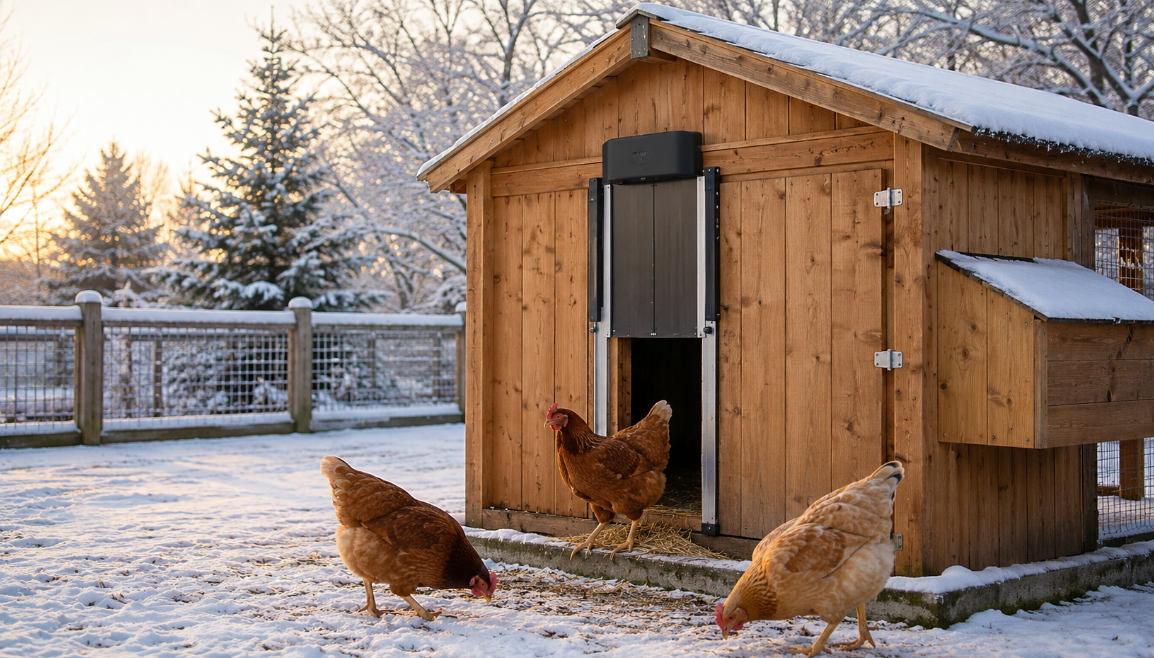
An automatic chicken coop door is supposed to make chicken keeping easier. In winter, the wrong setup can do the opposite: batteries can weaken, tracks can collect ice or bedding, snow can block the opening, and early darkness can make reliable closing more important than ever.
This guide focuses on automatic coop doors that are worth considering for cold weather based on manufacturer information, available product documentation, and limited owner feedback found during research. Coop Automation Lab has not personally tested these doors, so cold-weather claims are handled carefully. When a brand says a door is rated for a certain temperature, designed for snow, or resistant to predators, treat that as a manufacturer claim unless stated otherwise.
Quick recommendations
| Product | Best for | Power source | Winter notes | Key caution | Check price |
|---|---|---|---|---|---|
| Omlet Smart Autodoor | Polished all-around setup | 4 AA batteries or optional mains power | Manufacturer says tested from -4°F to 150°F; IPX6 casing; safety sensors | No official solar support found in reviewed product info | Check Price |
| Run-Chicken T50 | Simple battery-powered door | 2 AA batteries | Designed for heat, cold, snow, and icing; Power Mode for ice/snow/debris | No clear official operating temperature range found | Check Price |
| Run-Chicken Eternal | Integrated solar option | Built-in solar cell + rechargeable batteries | Same snow/icing language and Power Mode as T50 | Winter solar reliability depends on sun, shade, snow, and location | Learn More |
| ChickenGuard Pro / Pro Solar / All-in-One | Flexible power choices | AA batteries, mains, or solar depending model | Weather resistance, anti-crush features, winter motor boost | “Weatherproof down to -20°” needs unit confirmation before relying on it | Learn More |
| ADOR1 | Heavy-duty steel construction | 6V lantern battery; optional 120V kit | Manufacturer states -20°F to 115°F operating range | Obstruction alerts are not the same as verified anti-crush/reverse behavior | Learn More |
How to choose an automatic coop door for winter
Cold-weather performance is not just about the lowest temperature printed on a product page. A coop door can be rated for cold air and still have problems if snow piles up, bedding freezes in the track, the battery weakens, or the door is mounted where wind-driven rain turns into ice.
Before choosing a door, look at these winter-specific criteria. For a broader comparison of control types, power options, and door designs, see our best automatic chicken coop doors buyer’s guide.
1. Power reliability in freezing weather
Batteries often perform worse in cold weather. A door that works for months in spring or fall may need more frequent battery checks during a long freeze.
Look for:
- battery type and quantity
- stated battery life
- low-battery warning
- manual override
- mains/plug-in option
- solar support, if useful for your coop
- how the door behaves when power is low
If your coop is close to an outlet, a mains-compatible door can be more predictable than a battery-only setup. If your coop is remote, battery or solar may be more practical, but you should plan for winter checks.
2. Ice, snow, bedding, and track design
Most automatic chicken coop doors move vertically or slide in rails. Rails and lower edges can collect:
- pine shavings
- dust
- frozen mud
- frost
- snow
- ice
- feathers
A stronger motor or “power boost” mode can help, but it does not make any door freeze-proof. Even a good winter door needs inspection and occasional cleaning.
3. Manual override
A winter coop door should have a backup plan. If the motor jams, the battery dies, or the sensor behaves unexpectedly, you need a way to open or close the door yourself.
Useful backup features include:
- physical open/close button
- control panel manual mode
- app/manual mode
- emergency hand release
- low-battery warning
- obstruction alert
Manual override matters most during bad weather because that is when a stuck-open door can create predator risk and a stuck-closed door can trap chickens inside or outside.
4. Closing safety
Some automatic doors include anti-crush or obstruction detection. Others detect load, stop, reverse, retry, or sound an alert. These features are not all identical.
Before relying on a safety claim, verify in the manual:
- whether the door stops when blocked
- whether it reverses
- whether it retries closing
- whether it alerts you
- whether the feature is meant to protect birds or only protect the motor
Small birds, slow-moving hens, chicks, and cluttered doorways require extra caution. Do not assume a door is safe for chicks unless the manufacturer specifically supports that use.
5. Predator resistance, not “predator-proof” guarantees
Many brands describe locking doors, motor locks, strong materials, or predator-resistant designs. Those features can help, but predator protection also depends on installation.
A raccoon, fox, dog, mink, or other predator may exploit:
- gaps around the frame
- weak coop siding
- loose screws
- flexible mesh
- reachable latches
- a door that fails to close
- snow or bedding that prevents full closure
For that reason, this guide avoids treating any automatic door as a guaranteed predator-proof solution. Think of the door as one part of a secure coop system.
Best automatic chicken coop doors for cold weather
1. Omlet Smart Autodoor
Best for: chicken keepers who want a polished, mainstream automatic door with documented manufacturer cold-temperature testing and safety sensors.
Check Omlet Smart Autodoor on Amazon
The Omlet Smart Autodoor is one of the better-known automatic coop doors for backyard flocks. It is often considered by owners who want a complete door and controller rather than a DIY opener.
Manufacturer claims and specs to note:
- Tested by Omlet to work from -4°F to 150°F
- Powered by 4 AA batteries, with claimed battery life up to 6 months
- Optional mains power cable available
- Waterproof casing to IPX6 standards
- ABS construction with zinc gearing and steel fixings
- Built-in safety sensors designed to stop the door if something is in the way
- Light sensor, timer, and manual/app control depending on model/setup
- Manual function through the control panel
- Compatible with Omlet Eglu Cube, wooden coops, and mesh/enclosures with mounting kits
Why it may work well in winter:
The most useful winter detail is the stated temperature range. A specific low-temperature claim is more helpful than vague “weatherproof” wording. The optional mains power cable is also useful if you want to avoid relying only on batteries during cold snaps.
The IPX6 casing claim is relevant for storms and wind-driven moisture, though waterproof casing does not mean the moving door parts cannot be affected by snow, ice, or debris.
Owner feedback found during research:
Manufacturer-hosted reviews include positive comments about cold-weather operation and reliable light-based opening. Treat this as owner feedback hosted by the manufacturer, not independent testing by Coop Automation Lab.
Potential drawbacks:
- No official solar support was found in the reviewed product information.
- The warranty term should be verified before publishing.
- The opening dimensions should be checked against official documentation before making breed-size recommendations.
- The -4°F claim is a manufacturer test claim, not independent testing.
Best fit:
Choose the Omlet Smart Autodoor if you want a well-documented, polished door with battery and optional mains-power choices.
Avoid if:
You specifically need built-in solar charging, or your winter temperatures regularly fall far below Omlet’s stated low-temperature claim.
2. Run-Chicken T50
Best for: chicken keepers who want a compact, simple, battery-powered door with winter-oriented motor features.
Check Run-Chicken T50 on Amazon
The Run-Chicken T50 is a popular all-in-one automatic coop door with app-based controls and a compact aluminum design. For winter buyers, the important point is not just that it is battery-powered; it is that Run-Chicken specifically describes snow, ice, and debris handling features.
Manufacturer claims and specs to note:
- Powered by 2 AA batteries
- Manufacturer-stated battery life of approximately 1 year
- Aluminum, powder-coated construction
- Opening dimensions: 8 in × 10 in
- Door dimensions: 9.5 in × 14 in
- Full open height: 24 in
- Weight: 1.8 lb
- Designed to withstand heat, cold, snow, and icing conditions
- “Power Mode” increases motor force to help overcome ice, snow, and debris buildup
- Anti-pinch mode stops and reverses when resistance is detected, then attempts to close again
- Motor-locking system intended to prevent predators from lifting the door
- App-based sunrise/sunset, timer, manual control, and battery status
- Warranty information from FAQ: 1 year, with registration within 30 days; coverage for defects in materials/workmanship, excluding misuse/damage/improper maintenance
Why it may work well in winter:
The Power Mode feature is directly relevant to winter because the brand says it helps with ice, snow, and debris buildup. The app battery status is also useful because cold-weather battery drain is one of the main winter worries.
The compact all-in-one format may appeal to people who want a straightforward installation without separate strings, pulleys, or a large external control box.
Owner feedback found during research:
No independent third-party owner feedback was gathered in the research packet. Final content should ideally review retailer reviews and chicken-keeping forum discussions for winter complaints before publishing.
Potential drawbacks:
- No clear official operating temperature range was found during research.
- “Designed to withstand snow and icing” is a manufacturer claim, not a guarantee the door will clear every frozen obstruction.
- App/manual control is useful, but final copy should verify whether there is a physical emergency release or only app-based/manual operation.
- Rails still require cleaning; ice, bedding, and debris can affect any sliding door.
Best fit:
Choose the Run-Chicken T50 if you want a battery-powered door with app controls and manufacturer-described winter assist features.
Avoid if:
You need a clearly published low-temperature operating range before buying, or you want an integrated solar charging system.
3. Run-Chicken Eternal Door
Best for: chicken keepers who like the Run-Chicken format but want integrated solar charging.
The Run-Chicken Eternal uses a similar style to the T50 but adds an integrated solar cell and rechargeable batteries. That makes it especially interesting for remote coops where running power is inconvenient.
Manufacturer claims and specs to note:
- Integrated solar cell continuously recharges batteries
- Rechargeable batteries included
- Manufacturer says batteries can operate for more than 5 years before replacement under normal conditions
- Aluminum, powder-coated construction
- Opening dimensions: 8 in × 10 in
- Door dimensions: 9.5 in × 14 in
- Designed to withstand heat, cold, snow, and icing conditions
- Power Mode helps overcome ice, snow, and debris buildup
- Anti-pinch stop/reverse/retry behavior
- Motor-locking system intended to prevent predators from lifting the door
- App-based sunrise/sunset, timer, and manual app control
Why it may work well in winter:
Integrated solar charging is convenient if the coop gets reliable sun and the panel stays clear. For some backyard coops, that can reduce battery changes and make the door more self-sufficient.
The same Power Mode language as the T50 is relevant for snow, ice, and debris, though it should still be treated as a manufacturer claim.
Owner feedback found during research:
No independent owner feedback was gathered for this product in the research packet.
Potential drawbacks:
- Solar performance in winter depends on short days, cloudy weather, shade, panel angle, snow cover, and latitude.
- Battery replacement wording should be checked carefully on the current product page and manual, especially if you are relying on solar charging through winter.
- We did not find independent evidence proving reliable solar charging through long northern winters, so treat winter solar performance as location-dependent.
Best fit:
Choose the Run-Chicken Eternal if your coop gets good winter sun and you want an integrated solar option without building your own charging setup.
Avoid if:
Your coop is shaded, snow often covers the panel, or you live in a cloudy northern area where winter solar reliability is uncertain.
4. ChickenGuard Pro, Pro Solar, and All-in-One models
Best for: chicken keepers who want flexible power choices and a brand that emphasizes winter motor assistance.
ChickenGuard has several automatic door/controller options, including Pro, Pro Solar, All-in-One, and All-in-One Solar variants. The exact best choice depends on whether you want a controller for an existing-style door or a more complete all-in-one setup.
Manufacturer claims and specs to note:
- Pro page states “Weatherproof down to -20°,” but the unit was not clear in fetched research text
- Pro can use AA batteries, DC mains supply, or solar panel depending on setup/accessories
- All-in-One can use 4 AA batteries, compatible solar panel, or 9V DC mains power
- IP44 water-resistant rating found in research
- Winter mode / motor power boost to help with snowy or icy conditions
- Anti-crush detection, including stop/reverse behavior and an anti-crush bar on current models
- Light sensor, timer, and manual override features are part of the brand’s positioning and reviewed material
- Manufacturer states 3-year warranty on auto coop doors
- Site claims ASA plastic does not warp, bend, or jam; product-specific material should be verified before final copy
Why it may work well in winter:
ChickenGuard’s main winter advantage is flexibility. Battery, mains, and solar options let you choose a power setup based on your coop location. The winter motor boost is also relevant for snow and ice concerns.
The 3-year warranty claim is stronger than the 1-year warranties found for some other products, but it should still be verified on the exact model page before publishing.
Owner feedback found during research:
Manufacturer-hosted reviews included positive comments about easy installation/programming, good support, and one report of a solar panel keeping batteries charged during gloomy February weather. Research also found a negative owner comment about supplied batteries lasting only a few days. Treat these as owner feedback from manufacturer-hosted reviews, not independent verification.
Potential drawbacks:
- The “-20°” temperature claim needs unit confirmation before final publication. Do not assume Fahrenheit or Celsius.
- Current and legacy ChickenGuard model names/specs can be confusing. Avoid mixing Standard, Premium, Extreme, Pro, and All-in-One details unless each claim is tied to a specific current model.
- IP44 means water-resistant, not waterproof or submersible.
- Solar kit contents and battery requirements vary by model and package.
Best fit:
Choose ChickenGuard if you want flexible power choices, a longer stated warranty, and winter-specific motor assistance.
Avoid if:
You want the simplest possible product page/spec sheet or do not want to sort through multiple model and kit variations.
5. ADOR1 Automatic Chicken Coop Door
Best for: chicken keepers who prefer heavy-duty steel construction and a larger opening.
Learn more about the ADOR1 Automatic Chicken Door
ADOR1 is a different style from many plastic or lightweight aluminum all-in-one doors. It uses heavy galvanized steel and a sprocket-drive design, and the manufacturer provides a specific operating temperature range.
Manufacturer claims and specs to note:
- Operating temperature: -20°F to 115°F
- Powered by included 6V DC lantern battery
- Optional 120V power kit available
- Heavy-duty 20-gauge galvanized steel construction
- Opening size: 13 in H × 10.5 in W
- Door travel: under 12 seconds open to closed
- Self-tests for battery voltage, load, and limit detection
- Low battery, obstruction, and timeout alerts through buzzer/LED, with optional external alarm
- Engaged sprocket drive, bottom guard rail, and steel construction described for predator resistance
- Built-in pushbutton for manual open/close that returns to automatic mode
- Infrared daylight sensing for sunrise/dusk operation
- “Last Call” option re-opens for late-returning hens
- Warranty: 1 year against manufacturing/material defects
Why it may work well in winter:
ADOR1 has one of the clearer manufacturer-published cold ranges in the research packet: -20°F to 115°F. The steel construction and larger opening may appeal to people who want something heavier-duty than lightweight plastic designs.
The alerts and diagnostics are also useful in winter because a low battery or obstruction can become a serious flock-safety issue after dark.
Owner feedback found during research:
No independent owner feedback was collected in this research run. Manufacturer claims about units in the field and years of production should be treated as manufacturer claims.
Potential drawbacks:
- No solar support was found on the product page reviewed.
- Obstruction alerts and timeout detection should not be described as anti-crush protection unless the manual confirms bird-protection behavior.
- Heavy vertical mechanisms can still be affected by frozen debris, poor installation, or obstruction.
Best fit:
Choose ADOR1 if you want a larger opening, steel construction, a physical pushbutton override, and a clearly stated manufacturer temperature range.
Avoid if:
You want integrated solar charging or app-based control.
Solar vs battery vs plug-in power for winter
Power source matters more in winter than in mild weather.
Battery-powered doors
Battery doors are simple and work well for remote coops, but cold can reduce battery performance. If you use a battery door, check batteries before storms and cold snaps, and keep spares on hand.
Best for:
- coops without power
- simple installation
- owners willing to check batteries regularly
Watch out for:
- cold-related battery drain
- weak batteries causing partial closes
- no alert system
- hard-to-access battery compartments during snow or ice
Solar-powered or solar-assisted doors
Solar can be helpful, but winter is the hardest season for it. Short days, clouds, shade, low sun angle, and snow-covered panels can all reduce charging.
Best for:
- sunny coop locations
- remote coops
- owners who can mount the panel well
- climates with reasonable winter sun
Watch out for:
- shaded runs
- panels mounted too flat
- snow covering the panel
- cloudy stretches
- unclear backup battery behavior
Plug-in or mains-compatible doors
If your coop has safe access to power, a plug-in option can reduce battery worries. Outdoor electrical work must be done safely, with appropriate weather protection and code-aware installation.
Best for:
- coops near the house or barn
- very cold climates
- owners who want fewer battery checks
Watch out for:
- unsafe extension cord setups
- power outages
- water exposure
- lack of battery backup
Winter installation tips
A good door can still fail if it is mounted badly. For winter, installation matters.
Use these practical steps:
- Mount the door where snow will not pile directly against it. Avoid low spots where drifting snow blocks the entrance.
- Keep the track and threshold clean. Bedding and dust can freeze into a hard obstruction.
- Protect the control box. Weather-resistant does not mean it should be blasted with roof runoff or wind-driven slush.
- Test the door before relying on it. Watch several open/close cycles in cold weather.
- Check settings after daylight changes. Timer and light-sensor schedules may need seasonal adjustment.
- Keep spare batteries available. Replace or recharge batteries before deep cold when possible.
- Verify manual override. Make sure you can open or close the door quickly if automation fails.
- Inspect predator gaps. A strong door does not help if there is a gap around the frame.
- Do not let ice build around the lower edge. The final inch of closure matters for predator resistance.
- Check late-returning chickens. Short winter days can change flock behavior.
Safety caveats before buying
Automatic coop doors are useful, but they are not a substitute for checking your flock.
Keep these cautions in mind:
- No automatic door is guaranteed predator-proof.
- Anti-crush and obstruction features vary by product.
- Solar reliability is location-dependent.
- Battery life claims may be shorter in real winter conditions.
- Manufacturer weather ratings do not eliminate ice and snow maintenance.
- Very young chicks may not be appropriate for automatic-door reliance unless the manufacturer clearly supports that use.
- Always follow the manufacturer’s installation instructions.
FAQ
Do automatic chicken coop doors work in freezing weather?
Some do, but performance depends on the specific door, installation, batteries, snow exposure, and maintenance. Look for a published operating temperature range, manual override, low-battery alerts, and clear guidance on snow/ice maintenance.
Can an automatic chicken coop door freeze shut?
Yes. Any moving door can potentially freeze shut if ice forms around the track, threshold, or door edge. A stronger motor may help with light resistance, but it should not be treated as freeze-proof.
Is a solar automatic chicken coop door reliable in winter?
It can be, but only if the panel gets enough sunlight and stays clear of snow. Solar performance is worse in short, cloudy winter days, especially in shaded or northern locations. A backup battery or manual override is important.
Is a timer or light sensor better in winter?
Both can work. A timer is predictable but may need seasonal adjustment as daylight changes. A light sensor follows sunrise/sunset more naturally, but placement matters because shade, coop lights, storms, or snow reflection can affect readings.
Are automatic coop doors predator-proof?
Do not assume that. Some doors have locking designs or predator-resistant features, but actual protection depends on the entire coop: walls, frame, screws, gaps, mesh, and whether the door closes completely every night.
What is the best power source for cold climates?
If safe power is available, a mains-compatible door can reduce battery concerns. If power is not available, use a quality battery-powered or solar-assisted door, check batteries often, and verify winter behavior before relying on it fully.
How do I stop my automatic coop door from freezing?
Mount it away from direct snow buildup, keep tracks clean, prevent roof runoff from dripping onto the door, remove ice around the threshold, and test the door during cold snaps. Follow the manufacturer’s maintenance instructions.
Bottom line
For cold-weather coops, choose the door around your winter failure risk: power reliability, ice or snow around the opening, safe closing behavior, manual override, and secure installation. Manufacturer cold-weather claims are useful, but they are not a substitute for checking the door during freezing weather and keeping tracks or thresholds clear.